

Nattokinase Explained: Benefits, Effects, and Potential Uses
Nattokinase is currently one of the most popular enzymes used in dietary supplements. It is valued by consumers and is the subject of extensive scientific research. The enzyme is derived from the traditional Japanese fermented soybean food natto and is of particular interest for its potential role in cardiovascular health, healthy blood flow, and its fibrinolytic properties.
As experts in high-quality dietary supplements, we explain what nattokinase is, how the enzyme works, and what it is commonly used for. You'll also learn about the current scientific evidence regarding its potential applications for cardiovascular and liver health, as well as which nattokinase products from our range may complement a health-conscious lifestyle.

What Is Nattokinase?
Nattokinase is an enzyme derived from fermented soybeans. It originated in Japan, where the traditional food natto has been enjoyed for centuries and is considered a delicacy. To produce natto, cooked soybeans are fermented using a specific bacterium. During this fermentation process, nattokinase is naturally formed.
In Europe, natto is rarely consumed due to its strong and distinctive flavor. Instead, nattokinase is primarily known as a dietary supplement and is commonly used in connection with cardiovascular health, healthy blood flow, and vascular health.
Nattokinase: How Does the Enzyme Work?
Over the past several years, scientific research has increasingly focused on the potential mechanisms of action of nattokinase. In particular, researchers have investigated its fibrinolytic properties, including its potential role in the breakdown of fibrin and its possible effects on various aspects of cardiovascular health.
A key component of this process is the body's own enzyme plasmin. Plasmin plays a crucial role in the natural breakdown of fibrin, a protein formed during blood clotting. Scientific studies suggest that nattokinase may support the activation of plasmin or enhance plasmin activity, thereby promoting the body's natural fibrinolytic processes. In this way, the enzyme may indirectly support the natural breakdown of fibrin.
However, many of these mechanisms are still under investigation, and the available evidence is not yet conclusive. Below, we summarize the current state of research and the mechanisms of action that have been identified so far.

What Is Nattokinase Good For?
The current body of scientific evidence on nattokinase shows mixed results. While many studies provide promising indications of potential benefits, its long-term effects have not yet been fully established. Therefore, the following information should be understood as findings from current research rather than proven medical effects.
Nattokinase and Cardiovascular Health
In the context of cardiovascular health, nattokinase has been studied primarily for its potential effects on blood pressure. Some studies suggest that taking nattokinase may be associated with reductions in blood pressure. In certain studies, an average decrease of approximately 5.55 mmHg has been observed.
For this reason, nattokinase has attracted considerable scientific interest, particularly in relation to high blood pressure and overall cardiovascular health. However, the available evidence remains heterogeneous, and further research is needed to confirm these findings.
As part of a heart-healthy diet, omega-3 fatty acids are also frequently discussed because they contribute to the normal function of the heart. Many people therefore choose to complement their diet with Omega-3 Drops, which are also available in our product range, to support a balanced nutrient intake.

Nattokinase and Blood Clotting
Nattokinase is best known for its association with blood clotting. The enzyme is often referred to as a "natural blood thinner" because studies have linked it to fibrinolytic processes.
In a study involving more than 1,000 participants, positive effects on various blood lipid levels were also observed. Researchers have further discussed whether nattokinase may help support healthy circulation and influence the formation of blood clots.
These findings are scientifically promising, but they have not yet been conclusively established. Potential effects on the risk of heart attack, stroke, and thrombosis are also still being investigated.

Nattokinase: Potential Effects on Inflammation
Animal studies, particularly those conducted in mice, have also provided evidence suggesting that nattokinase may possess antioxidant and anti-inflammatory properties. In these studies, nattokinase appeared to reduce oxidative stress and potentially influence certain inflammatory markers. However, these findings are based primarily on preclinical research, meaning their relevance to humans remains uncertain.
In nutritional science, antioxidants and plant-based compounds are also discussed in this context, as oxidative stress is considered a potential factor affecting cellular health. For this reason, many of our customers choose to complement their diet with antioxidant supplements, such as OPC Drops or Vitamin E, to help support the body's natural defense against oxidative stress.
Bio Nattokinase Kapseln
120 Presslinge · 1.400–1.600 FU je Pressling
Sofort lieferbar · Versand heute

Nattokinase: Potential Effects on Liver Health
Initial research has also explored the potential effects of nattokinase on liver function. The liver plays a central role in regulating blood clotting factors, which is why enzymes such as nattokinase may theoretically be involved in these processes indirectly.
In a study by Hideaki Suzuki et al., the co-administration of nattokinase was reported to significantly improve markers of liver function. Researchers observed reductions in the liver enzymes ALT and AST, as well as a decrease in ALP levels. These findings suggest potential hepatoprotective effects, although further research is needed to confirm these results.

„Dieses Produkt ist Spitze und ist sehr gut verträglich. Ein hervorragender pflanzlicher Blutverdünner.“
„Schnelle Lieferung. Sehr gut verträglich. Super finde ich, dass kein unnötiger Überzug und damit verbunden auch keine weiteren Stoffe verwendet werden, die man nicht im Körper haben will […]“
„Ich nehme jeden Tag einen Pressling und fühle mich gut, keine Nebenwirkungen. Es hat auch einen angenehmen Geschmack.“
„Ich mache jetzt schon das zweite Mal einen 4-wöchigen Zeitraum zur Vorbeugung. vertrage es super und meine eine bessere Durchblutung zu spüren.“
„Nehme es jetzt seit mehr als eine Woche und bin sehr zufrieden. Werde auf jeden Fall nachbestellen.“
„Die Bestellung wurde super schnell und gut verarbeitet und versendet. Die Dosierung mit D3 gefällt uns sehr gut.“
How to Take Nattokinase: Dosage and Use
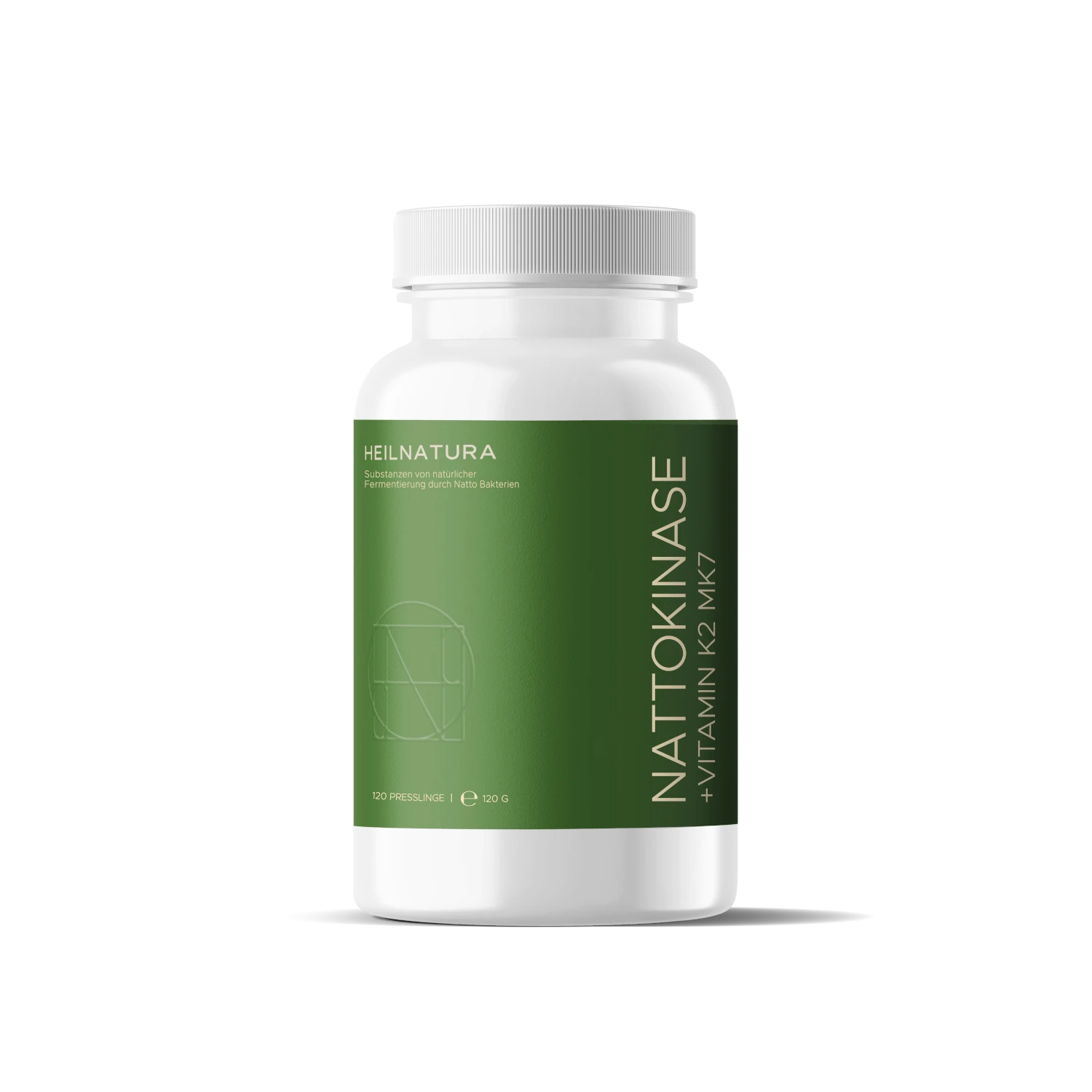
Nattokinase is typically taken as a dietary supplement in capsule form, making it easy to incorporate into your daily routine. At Heilnatura, for example, we offer our Nattokinase Capsules as well as Nattokinase + D3 and K2, which may also help support the normal function of the immune system. Both products are manufactured to high quality standards and are formulated for excellent bioavailability.
For optimal absorption, nattokinase is often recommended on an empty stomach, as this minimizes interference from the digestive process. It should also be taken with plenty of fluids, ideally a large glass of water. The appropriate dosage may vary depending on the product and individual circumstances. As a general rule, always follow the manufacturer's recommended dosage instructions and do not exceed the stated daily intake.

Maintaining the body's energy levels is also important in everyday life. During periods of increased stress or fatigue, our Magnesium Complex can provide additional support and contribute to the normal function of the nervous system.
What Should You Consider When Taking Nattokinase?
Although nattokinase may offer a range of potential benefits, its use should be carefully considered. Because nattokinase may influence blood clotting, it is generally recommended to stop taking it at least 14 days before any planned surgery.
Special caution is also advised if you are already taking blood thinners or anticoagulant medications. As potential interactions cannot be ruled out, nattokinase should only be taken under medical supervision in these situations or, if necessary, avoided altogether.

People with a soy allergy should also avoid nattokinase supplements, as the enzyme is derived from fermented soybeans and may trigger allergic reactions. In addition, there is some evidence suggesting that nattokinase may affect the menstrual cycle in certain women.
As a general rule: If you are pregnant, breastfeeding, have a chronic medical condition, or take medication on a regular basis, you should always consult your healthcare provider or pharmacist before taking nattokinase. This will help determine whether the supplement is appropriate for your individual situation.
Effects of Nattokinase on the Thyroid
At present, there are no robust clinical data confirming a direct effect of nattokinase on thyroid function. In this context, however, researchers often consider natto, the traditional food from which nattokinase is derived. Natto is made from fermented soybeans, which are classified as goitrogenic foods.
This means they may interfere with normal thyroid function under certain conditions, particularly when consumed very frequently and in large amounts. However, these properties are associated with soybeans themselves and not specifically with the isolated enzyme nattokinase.

- 100 % fermentiertes Natto mit natürlichem Vitamin K2 MK7
- Spermidin, Isoflavone, Vitamin B9, Phosphor, Eisen
- Für alle, die Vitamin D bereits separat einnehmen

- Zusätzlich 25 µg Vitamin D3 (1000 IE) aus Meeresalgen
- D3 und K2 MK7 für Immunsystem, Muskeln und Knochen
- Zwei Präparate in einem Pressling – eine Einnahme am Tag
Quellen & weiterführende Informationen
Für diesen Ratgeber wurden insbesondere wissenschaftliche Originalarbeiten, klinische Studien und Übersichtsarbeiten aus der biomedizinischen Fachliteratur herangezogen.
-
Jang et al.: A single-dose of oral nattokinase potentiates thrombolysis and anti-coagulation profiles
Humanstudie zu möglichen Auswirkungen einer einmaligen Nattokinase-Einnahme auf Gerinnungs- und Fibrinolyseparameter.
PubMed – Studie ansehen -
Kim et al.: Effects of nattokinase on blood pressure: a randomized, controlled trial
Randomisierte, doppelblinde und placebokontrollierte Studie zu möglichen Auswirkungen von Nattokinase auf den Blutdruck.
PubMed – Studie ansehen -
Nattokinase Supplementation and Cardiovascular Risk Factors: A Systematic Review and Meta-Analysis of Randomized Controlled Trials
Systematische Übersichtsarbeit und Meta-Analyse randomisierter Studien zu Nattokinase und verschiedenen kardiovaskulären Risikofaktoren.
PubMed – Übersichtsarbeit ansehen -
Chen et al.: Effective management of atherosclerosis progress and hyperlipidemia with nattokinase: A clinical study with 1,062 participants
Retrospektive klinische Untersuchung mit 1.062 Teilnehmenden zu Nattokinase, Blutfettwerten und Parametern der Atherosklerose.
PubMed – Studie ansehen -
Wu et al.: Breaking the vicious loop between inflammation, oxidative stress and coagulation
Präklinische Untersuchung zu möglichen entzündungshemmenden und antioxidativen Eigenschaften von Nattokinase.
PubMed – Studie ansehen -
Elbakry et al.: Nattokinase attenuates bisphenol A or gamma irradiation-mediated hepatic and neural toxicity
Tierexperimentelle Untersuchung zu möglichen Auswirkungen von Nattokinase auf oxidativen Stress, Entzündungsprozesse und verschiedene Leberparameter.
PubMed – Studie ansehen -
Cummings et al.: Preoperative Management of Surgical Patients Using Dietary Supplements
Konsensuspapier der Society for Perioperative Assessment and Quality Improvement zum Umgang mit Nahrungsergänzungsmitteln vor geplanten Operationen.
PubMed – Konsensuspapier ansehen


